The place you return to is always slightly different
Drive My CarThe place you return to is always slightly different is Kafuku’s account of how experience alters the self even when a person resumes an earlier role or identity. First articulated in a conversation with Misaki Watari about acting and his wife’s affair, the idea refuses the comfort of a perfect return: one may leave the self temporarily, but one cannot come back unchanged. The expression also describes the movement of the story itself, which ends by returning Kafuku to the language of the stage while leaving his understanding of the past incomplete.
Origins in Acting
Kafuku’s explanation begins with an accidental entrance into theater. A girl he knew at college invited him to join her theater club. Acting had not been his ambition; he had wanted to play baseball and had been the starting shortstop on his high school team, but he was not quite good enough for the college team. He accepted partly because he wanted to spend more time with the girl and partly because trying something new seemed worth doing. Only after he had been acting for a while did he recognize that he genuinely liked it.
What captivated him was the possibility of becoming someone other than himself and then reverting when the performance ended. He says he loved that possibility only on the condition that he knew he could go back. This qualification gives the later expression its starting point: acting seems to offer a temporary departure with a safe return, but Kafuku eventually recognizes that the return cannot restore an untouched original. The self who resumes the role carries the experience of having inhabited another one.
The distinction is not simply between a false stage identity and a true private identity. Kafuku describes performing as an experience he values in its own right, while the certainty of return is what initially makes it bearable. When Misaki asks whether he ever did not want to go back, he pauses to think; no one has asked him that before. The question unsettles the neat boundary between performance and ordinary life. Its timing matters too: they are heading toward the Takebashi exit on the Tokyo Metropolitan Expressway, where traffic is jammed, and the conversation itself lingers rather than moving cleanly onward.
Return Through Painful Knowledge
The expression acquires a more painful meaning when Kafuku explains why he drank and talked with the man who had slept with his wife. At first, he says, he wanted to understand why she had chosen that man. The inquiry was not detached: conversation brought him into contact with thoughts he would rather have ignored and memories he would rather have forgotten. He calls this acting, his profession, suggesting that he met the distress by taking up a role through which he could endure looking at it.
Misaki condenses the process into becoming somebody different and then going back to oneself. Kafuku agrees, but adds the qualification that defines the expression: “the place you return to is always slightly different from the place you left.” The change is unavoidable, whether it is wanted or not. His account does not claim that acting resolves pain or provides mastery over it. Instead, the role creates a way to approach difficult knowledge, and the approach itself changes the person who must return.
That change does not deliver the answer Kafuku sought. He never understands why his wife slept with the man. He can acknowledge that the man possessed qualities he lacked, perhaps many of them, but he cannot identify which qualities attracted her. His failure to specify the cause sharpens the difference between wanting to understand and actually reaching an explanation. The expression therefore marks an altered perspective, not a solved mystery: Kafuku has passed through the effort to know, but the reason for the affair remains beyond his grasp.
The Final Return
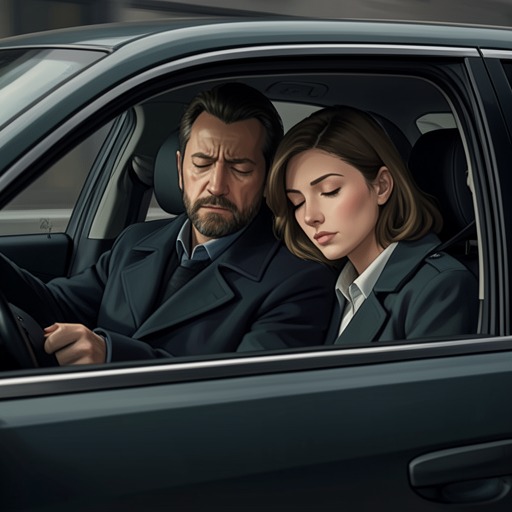
Near the end of the passage, Kafuku settles into the car’s leather seat and closes his eyes, trying to attend to the engine as Misaki shifts gears. He cannot catch the precise instant of each change; he detects only a slight gradation in the sound, compared to the approach and recession of an insect’s wings. The smoothness resists exact division into before and after. That listening image gives the expression a formal echo: change can be real without presenting itself as a clear boundary.
Kafuku decides to sleep for ten or fifteen minutes, then return to the stage, to bright lights, rehearsed lines, applause, and the falling curtain. His thoughts reprise the sequence of leaving oneself briefly and returning, but now state plainly that the returning self is never exactly the same as the one left behind. The performance is both a literal feature of his life as an actor and the image through which he understands survival after emotional strain. Sleep offers a brief interval, not an erasure of what came before.
Misaki does not answer when he says he is going to sleep. She studies the road quietly, and Kafuku is grateful for her silence. The close leaves the idea unargued and uncomfortably ordinary: there is no final explanation, only a driver continuing along the road and a passenger preparing to rest before going back to work. The expression’s force lies in that modest recurrence. Return is possible, but it is not restoration; even a familiar role begins again from a self subtly altered by what has happened.